

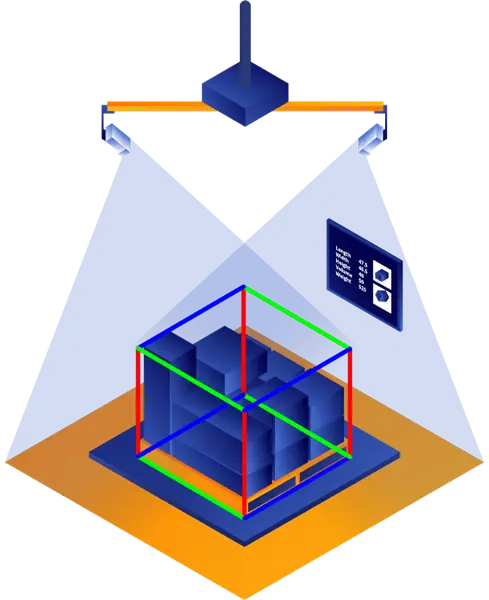
Buying a pallet dimensioner sounds simple until you start comparing options. Your dock layout, the freight you handle, and the software you already run all affect which unit makes sense. Get it right and you’ll ship faster and bill more accurately. Get it wrong and you’ve got an expensive machine that your team works around.
Start With Your Warehouse, Not the Spec Sheet
Before you look at any product, walk your dock. Check the ceiling height, the lighting, whether you already have a floor scale, and how forklifts actually move through the area. These things narrow your choices quickly, and they help you avoid a setup that needs changes to the building.
Overhead Mount vs. Floor Pallet Dimensioner
An overhead system mounts above your existing scale or staging spot. The big advantage is that the floor stays clear, so forklifts can move without going around equipment.
A portable or mobile unit is a better fit if you need to measure at several dock doors. You can wheel it where it’s needed instead of buying one per door.
Watch your dock for a few days. If freight always lands in the same spot, go fixed overhead. If it moves around, a mobile unit will save you headaches.
Check Software Compatibility Early
A dimensioner is only as useful as the system receiving its data. If your team has to retype measurements into your ERP, you’ve lost most of the benefit. Look for a unit that sends dimensions straight into the software you already use. With a pallet dimensioner that connects to Spectre Hub, captured data goes to the cloud right away, so anyone on your team can view and manage it from any web browser.
How to Pick a Pallet Dimensioner, Step by Step
Don’t try to decide everything at once. Work through these in order and the right option usually becomes obvious.
What to Do Before You Buy
- Figure out your average daily freight volume and your busiest hours. The unit has to keep up on the worst day, not the average one.
- Measure the clearance above your floor scale to make sure an overhead sensor will fit.
- Ask how the software connects. Cloud access and API options matter if you plan to link it with other systems.
- Check the measuring range. If you handle oversized or oddly shaped freight, confirm it can actually measure it.
- Look at the vendor’s support. Find out whether they offer remote monitoring and how fast they respond when something breaks.
Features Worth Paying For
- Fast scanning. A scan that takes a second or less keeps forklifts moving instead of queuing at the bay.
- A built-in camera. Photos taken during the scan give you proof of freight condition, which helps a lot when a damage claim comes up.
- Cloud data access. You should be able to pull up measurements from any browser, not just a computer on the dock.
- Few moving parts. Dust and vibration are hard on equipment. The fewer parts that move, the less there is to wear out.
Final Thoughts
The best pallet dimensioner is the one that fits your dock, handles your freight, and talks to your software. Start with the layout, be honest about your volume, and don’t skip the software questions. Do that, and you’ll end up with accurate measurements on every pallet and fewer billing disputes down the line.
Frequently Asked Questions
What ceiling height do I need for an overhead dimensioner?
Most overhead setups mount somewhere between eight and twelve feet above the measuring area. Exact numbers vary by model, so check the specs before you commit.
How often does a dimensioner need recalibration?
Newer solid-state optical sensors hold their calibration for a long time, and they need far less upkeep than older mechanical systems. Still, ask your vendor for their recommended check schedule.