

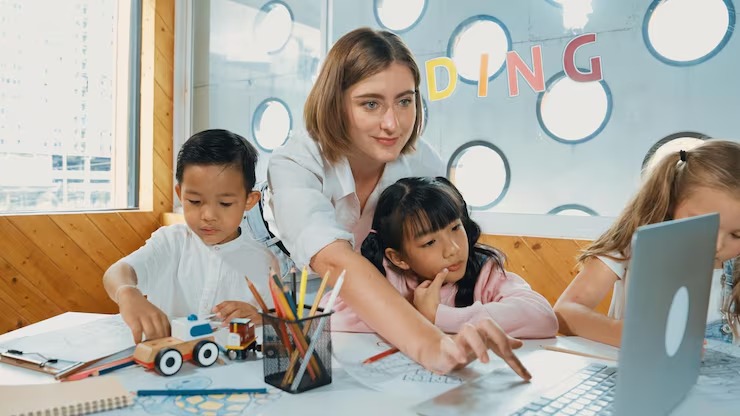
Every parent has watched it happen. A child stares at a math problem, clearly confused, then picks up an object, starts moving it around, and suddenly their face changes. Something clicked. That moment of physical interaction turning confusion into clarity is not accidental. It is the principle behind hands-on learning, and it is one of the most well-supported findings in educational psychology.
Young children understand the world through their bodies before they understand it through symbols. Abstract notation like numerals and equations represents concepts that children first need to experience concretely. Hands-on learning bridges that gap, making abstract ideas visible, touchable, and genuinely comprehensible.
Why Hands-On Learning Works for Young Children
How Hands-On Learning Activates Multiple Brain Pathways
When a child reads about a concept, they engage primarily with language processing areas of the brain. When they hear a concept explained, they add auditory processing. But when they physically interact with objects representing that concept, they engage sensory, motor, and spatial processing simultaneously. The resulting neural activity is far richer, and the resulting memory is far more durable.
SunStart’s teaching aids are designed specifically to leverage this principle. Children build structures, arrange and compare physical objects, sort shapes, and manipulate quantities with their hands. Each of these interactions creates a sensory memory of the mathematical concept that abstract instruction alone simply cannot produce.
Why Experiential Learning for Kids Goes Beyond Just Play
Experiential learning for kids at SunStart is carefully structured to ensure that hands-on exploration leads to genuine conceptual understanding. The physical component is always paired with guided reflection and expression. After children build and explore with teaching aids, they record what they discovered in workbooks and discuss their observations with parents or teachers.
This structured cycle transforms hands-on activity from enjoyable exploration into deep learning. Children do not just experience the concept. They observe it, articulate it, and connect it to a broader framework of mathematical thinking.
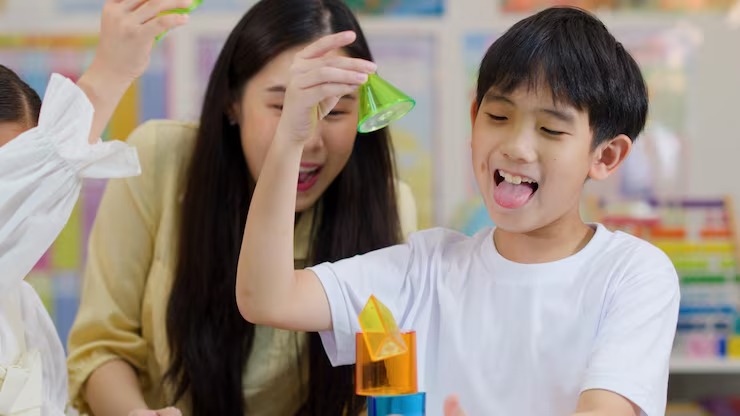
How SunStart Integrates Hands-On Learning Into Every Activity
The Teaching Aids That Make Abstract Math Concrete
SunStart’s hands-on teaching aids are at the heart of the physical learning experience. Children use these tools to build three-dimensional structures that make spatial concepts tangible. They sort and arrange objects to develop classification and comparison skills. They compare quantities to build genuine number sense.
The teaching aids are designed to work in concert with digital courseware and workbooks. A concept introduced through animation is immediately explored with physical objects, then reflected upon in the workbook. This multi-modal engagement ensures that children encounter each concept through multiple pathways, dramatically deepening their understanding.
The Long-Term Benefits of Hands-On Learning
- Stronger spatial reasoning that supports geometry and measurement in later grades
- Deeper number sense built through physical comparison and grouping
- Greater fine motor skill development through manipulation and building
- Confidence and willingness to try new approaches to challenging problems
- The ability to visualize mathematical relationships without needing physical props
These benefits compound over time. Children who learn through hands-on experience in their early years develop cognitive tools that make every subsequent stage of learning more accessible and more enjoyable.
What Hands-On Learning Looks Like at Different Levels
How Hands-On Learning Develops Across the SunStart Curriculum
At Level A, children aged three to four use teaching aids to explore basic concepts of quantity, comparison, and shape. The physical interaction is the primary mode of learning, with digital lessons providing context and workbooks capturing simple reflections.
By Level E, children aged seven to eight are using hands-on tools to explore complex spatial relationships, logical sequences, and multi-step problems. The physical component remains central, but it is now integrated with more sophisticated digital tasks and deeper workbook reflection.
This consistent integration of hands-on learning across all five levels ensures that the tactile dimension of understanding remains active even as the cognitive demands of the curriculum increase.
Conclusion
Hands-on learning is not a special accommodation for struggling learners or a fun diversion for advanced ones. It is the most natural and effective way for young children to build genuine mathematical understanding. SunStart’s integrated system makes this kind of learning systematic, intentional, and joyful, producing children who understand math deeply and approach new challenges with real confidence and curiosity.
Frequently Asked Questions
Q1: What specific teaching aids does SunStart use for hands-on learning? SunStart’s teaching aids include physical manipulatives for building three-dimensional structures, sorting and comparison tools, and spatial reasoning materials. They are designed to make concepts like number, quantity, shape, and space directly visible and tactile.
Q2: How does hands-on learning at home compare to hands-on learning in a structured program? Home activities provide valuable exploratory experience, but a structured program like SunStart ensures that exploration is connected to clear developmental goals and guided toward genuine conceptual understanding through a complete learning cycle.
Q3: Is hands-on learning appropriate for all children, including those with sensory sensitivities? SunStart’s multi-modal system allows children to engage primarily with digital or workbook components if needed. The program is designed to support diverse learning styles and needs.
Leave feedback about this