

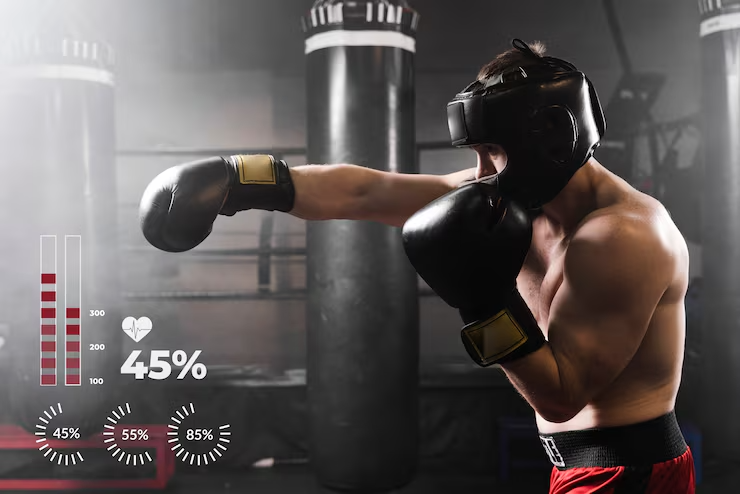
The best boxing reaction drills share one trait: they make you respond to a cue you can’t predict. Partner call outs, ball drops, reflex balls, double end bags, random pad work and lit targets all do it. The last one has a bonus, because you can time it. A boxing reaction trainer turns that last drill into a number.
Let’s go through all six. None of them needs fancy theory, and you can try most of them this week. The trick is to train reactions early in a session while you’re fresh, because fatigue slows everyone down.
Which drills train reactions best?
1. Partner call outs
A partner calls a number, and you throw the matching punch or combination right away. It’s low tech and it works. The calls should come at random, so you can’t prepare.
2. Tennis ball drop
Your partner holds a ball at shoulder height and drops it. You catch it before the second bounce, and once that feels easy, before the first. It sounds silly until you try it.
3. Reflex ball
A ball on an elastic cord attached to a headband trains your timing and eye tracking. It’s cheap, and it makes you humble quickly.
4. Double end bag
This bag comes back at you, so you punch and move your head in rhythm. It teaches you to react to something that’s moving, not static.
5. Pad work with random cues
The pad holder shows targets without any pattern. You can’t guess, so you have to read. This one also teaches the pad holder to stay unpredictable.
6. Light cue targets
A target lights up and you hit it as fast as you can. Here’s where it gets interesting, because the time can be measured exactly. A boxing reaction trainer such as DIGIPUNCH uses eight lit zones on a full heavy bag and times the gap from light to impact to 1 ms.
Why measure at all?
Because without a number, you’re guessing. With one, you can see what a good day looks like and whether four weeks of practice changed anything. A single reaction is far too variable to trust. Take the average of at least ten attempts, and compare like with like.
What’s a typical figure? For a simple visual signal, about 200 to 250 milliseconds is usual for healthy young adults. Hitting a target takes longer, so don’t judge yourself against that number directly. Judge yourself against last month.
How often should you practice?
Short blocks of five to ten minutes at the start of a session, two or three times a week, work well. More isn’t automatically better. Reaction time is clearly worse when you’re tired, so a long drill at the end of a hard workout teaches you little.
Sleep matters too, and so does a proper warm up. If you slept badly, expect slower numbers, and don’t take it personally.
What does a boxing bag with app add to the drills?
A boxing bag with app puts timing and recording in one place. On DIGIPUNCH, the Target Training workout in the free DIGI Coach app handles the cues and the clock. It also records punch force at the same time, so you can see whether you’re getting faster without getting lighter. That’s a useful check, because speed sometimes comes at the cost of power.
Every session is saved, so a month later you can look back and see the trend. The apps are free on iOS and Android, they work offline, and unlimited users can share the bag.
Can you mix the drills?
Of course. Warm up with partner call outs, spend ten minutes on lit targets and finish with freestyle. In Freestyle mode, DIGIPUNCH counts every punch anywhere on the bag, so you can throw combinations without hunting for a zone. The whole surface is the sensor, which means 360 degree detection from the front, side or back.
Nothing says you must use all six. Pick the ones you have space and a partner for. Even two drills, done regularly, will teach you more than a dozen done once.
Is it tough enough to hit hard?
Yes. DIGIPUNCH was made for heavy beating, and it took real punches from real fighters at Golden Gloves Fight Night. It measures up to 800 lb (360 kg) in a single punch, so you don’t need to hold back to protect it.
When can you get one?
DIGIPUNCH launches on Kickstarter on February 16, 2027. The free waitlist emails you when it opens, and a fully refundable $29 VIP spot reserves the $699 price. The team also plans testing locations in the USA, the UK and Germany.
Conclusion
Reaction drills work when they’re specific, unpredictable and repeated. Partner calls, ball drops, reflex balls, double end bags and random pad work all build the skill, and lit targets add something none of them can: an exact time. Average ten attempts, train early in the session and compare yourself with your own past results.
If you want that precision on a real heavy bag, DIGIPUNCH puts a boxing reaction trainer, a force meter and two free apps into one product. It’s not on sale yet, but the waitlist is free and takes seconds. Start with the drills this week, and by the time the campaign opens you’ll know exactly what to measure.